Tiruchirappalli

Politics

Politics

Political competition around Trichy constituencies intensifies

Political competition around the Tiruchirappalli (Trichy) constituencies has intensified significantly in the run-up to the 2026 Tamil Nadu Assembly election. Trichy has emerged as an important political battleground because of its central location, large urban and rural population, and influence over the surrounding Cauvery-region constituencies. The entry of Tamilaga Vettri Kazhagam (TVK) into the electoral contest has added another dimension to the competition among the major political parties. Major political parties in the contest The political landscape around Trichy involves several major parties and alliances, including the DMK, AIADMK, TVK, BJP and other regional and national parties. Each political formation has been attempting to strengthen its organisation and voter base across the district. The DMK has traditionally maintained a strong organisational presence in several parts of Trichy and has sought to retain its influence through its alliance network and development-oriented campaign. AIADMK has also continued to work to rebuild its support base, while the BJP has attempted to expand its presence in central Tamil Nadu. The emergence of TVK under actor-turned-politician Vijay has made the contest more competitive, particularly among younger voters. TVK’s entry changes the political equation TVK’s participation has been one of the most significant developments in Trichy’s political landscape. Vijay’s decision to contest from Tiruchirappalli East brought considerable attention to the constituency. His campaign attracted large crowds and generated substantial political discussion in the city. The party attempted to present itself as an alternative to the established political parties and focused heavily on issues such as corruption, employment, education, governance and the welfare of ordinary people. The presence of TVK has consequently forced established parties to pay greater attention to constituencies where the new party could attract first-time voters and younger sections of the electorate. Trichy East becomes a key constituency Tiruchirappalli East became one of the most closely watched constituencies because of Vijay’s personal involvement. His victory there gave TVK an important electoral foothold. However, Vijay later chose to retain Perambur and vacated Trichy East, creating a by-election situation and keeping the constituency politically significant. The subsequent contest attracted attention because it became a test of whether TVK’s support in Trichy was based primarily on Vijay’s personal popularity or whether the party had developed sufficient organisational strength to retain the seat. DMK’s organisational strength The DMK has a long-standing political presence in Tiruchirappalli. Its organisational network includes district-level leadership, constituency units, youth and women’s wings and other affiliated structures. The party has also used major political gatherings in the district to strengthen its organisation. The DMK’s large state conference at Siruganur demonstrated the importance the party attaches to Trichy as a political centre. DMK leaders have highlighted government schemes, infrastructure development, social welfare programmes and the party’s ideological position as important components of their campaign. AIADMK attempts to regain ground The AIADMK remains another important political force in the district. The party has sought to consolidate its traditional support base and challenge the DMK’s dominance in several constituencies. Its campaign has generally focused on issues such as inflation, unemployment, law and order, government performance and welfare schemes. The party’s ability to convert its traditional support into votes remains an important factor in determining the outcome of closely contested Trichy constituencies. BJP expands its presence The BJP has also attempted to strengthen its political organisation in Trichy. The party has increased its focus on urban voters and sought to expand its support beyond areas where it traditionally has a smaller electoral base. Political controversies, including disputes involving posters and criticism of national leaders, have also contributed to increased political activity involving the BJP in the city. Key issues influencing voters Several local and regional issues are expected to influence political competition in Trichy: Youth voters One of the most important factors in the political competition is the growing importance of young voters. TVK has particularly attempted to attract young people through Vijay’s popularity and its emphasis on political change. Established parties have also increased their focus on youth employment, education, entrepreneurship, technology and skill development. The ability of different parties to attract first-time voters could therefore influence close contests in urban Trichy constituencies. Three-way and multi-cornered contests The emergence of TVK has the potential to turn traditionally bipolar or alliance-based contests into three-way or multi-cornered contests. For example, a constituency may see strong competition between a DMK candidate, an AIADMK candidate and a TVK candidate, with the BJP or another party also affecting the vote distribution. In such contests, even a relatively small shift in votes can change the final result. Vote splitting therefore becomes an important factor in analysing Trichy’s electoral dynamics. Importance of Trichy for Tamil Nadu politics Trichy is not only important because of its individual Assembly constituencies. Its central geographical position makes it an important political and organisational hub for parties attempting to reach voters across central Tamil Nadu. Major political meetings, conferences and rallies held in the city often attract participants from neighbouring districts. As a result, political developments in Trichy can have significance beyond the district itself. Overall impact The increasing competition has resulted in greater political activity across Trichy. Parties are strengthening their local organisations, conducting public meetings, highlighting development issues and attempting to build support among different sections of voters. The contest is particularly significant because it combines traditional party loyalties with the emergence of a new political force. The DMK and AIADMK are relying on their established organisational networks, while TVK is attempting to convert Vijay’s popularity into a durable political organisation. The BJP, meanwhile, is seeking to expand its presence.
Politics

DMK’s major state conference held in Tiruchirappalli

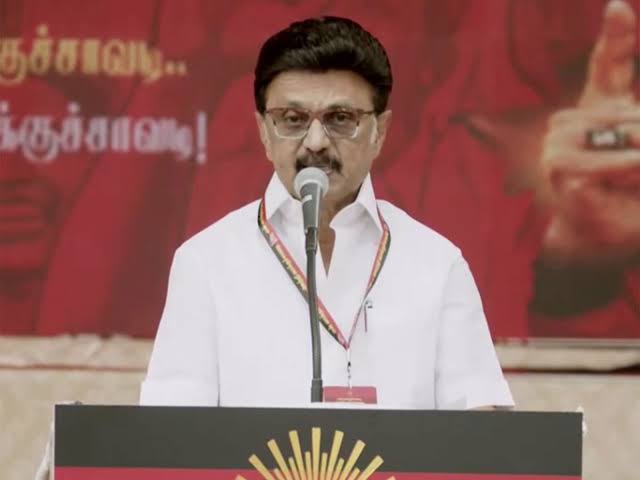
The Dravida Munnetra Kazhagam (DMK) held its 12th State Conference at Siruganur near Tiruchirappalli on March 9, 2026. The conference was one of the party’s largest organisational and political gatherings in the run-up to the 2026 Tamil Nadu Assembly election. The venue was established on a large tract of land along the Tiruchirappalli–Chennai National Highway, with extensive arrangements made for cadres and supporters arriving from across Tamil Nadu. Venue and large-scale arrangements The conference was organised at Siruganur, approximately along the Trichy–Chennai highway. Reports said the main conference area covered roughly 400 acres, while another 200 acres was earmarked for vehicle parking. The scale of the arrangements reflected the DMK’s expectation of a very large turnout. Around 10 lakh party cadres and supporters were expected to attend. Large seating arrangements, internal roads, drinking-water facilities, dining areas, LED screens and other infrastructure were created for the gathering. Reports also said food arrangements were planned for at least three lakh people. Theme of the conference The conference carried the slogan: “Stalin Thodarattum, Tamil Nadu Vellattum” which can be translated as “Let Stalin Continue, Let Tamil Nadu Win.” The theme reflected the DMK’s political objective of seeking another term under party president M. K. Stalin and presenting the conference as an important mobilisation event before the Assembly election. M. K. Stalin’s participation Tamil Nadu Chief Minister and DMK president M. K. Stalin was the central political figure at the conference. One of the major highlights was the hoisting of the DMK party flag on a 110-foot-high flagpole. The conference brought together party functionaries and cadres from different levels of the organisation, including district units and various party wings. This provided the leadership with an opportunity to communicate its election strategy directly to a very large gathering of party workers. Six major declarations The conference was also significant because Stalin was expected to make six major declarations concerning Tamil Nadu. These declarations formed part of the party’s broader political messaging ahead of the Assembly election and were intended to outline important priorities and commitments. Election preparation One of the main purposes of the Trichy conference was to strengthen the DMK’s organisation before the 2026 Assembly election. Party leadership used the gathering to: Stalin had earlier described the Trichy gathering as an important opportunity for party workers to prepare for the electoral contest. Why Tiruchirappalli was chosen Tiruchirappalli has a special place in the political history of the DMK. Senior party leaders have described Trichy as a political turning point for the organisation, particularly when major conferences are held there before elections. School Education Minister Anbil Mahesh Poyyamozhi said that major DMK conferences in Trichy had historically been associated with important political turning points for the party. The city’s central location within Tamil Nadu also makes it suitable for bringing party workers from northern, southern and western parts of the state together. Political significance The conference took place amid intense political competition ahead of the 2026 Assembly election. The DMK used the event not merely as a traditional party conference but as a large-scale political mobilisation programme. The conference also became a platform for Stalin to attack political opponents and discuss the DMK’s approach to the upcoming electoral contest. At the conference, Stalin accused the BJP of adopting strategies aimed at gaining political influence in Tamil Nadu and said the DMK would expose what he described as the BJP’s political agenda. Importance for Tiruchirappalli The event further strengthened Tiruchirappalli’s reputation as an important political centre of Tamil Nadu. The district has increasingly attracted major political rallies, party conferences and election-related programmes because of its central geographical position and importance in the state’s political landscape. The conference also generated significant logistical activity in the region, including transportation arrangements, traffic management, accommodation, food distribution and security preparations. Historical importance The DMK’s choice of Trichy was also connected to the party’s belief that the city has historically played an important role in its electoral journey. Party leaders highlighted the idea that success in Trichy could have wider political implications across Tamil Nadu. DMK MP Arun Nehru, for example, described Trichy as a political nerve centre where electoral success has historically been associated with wider statewide victories.

Politics

Vijay’s TVK makes Tiruchirappalli a major political centre

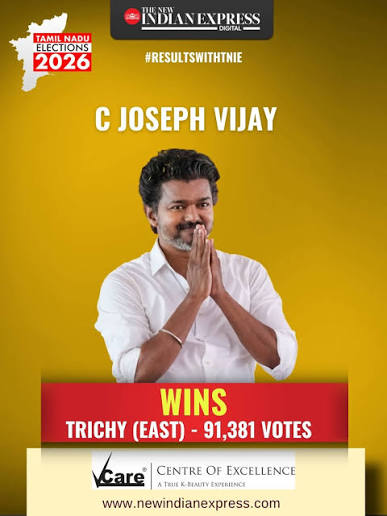
Tiruchirappalli (Trichy) has emerged as an important political centre for Tamilaga Vettri Kazhagam (TVK) and its president, C. Joseph Vijay, following the 2026 Tamil Nadu Assembly election. The city gained particular political importance because Vijay contested and won from Tiruchirappalli East, while also contesting from Perambur in Chennai. TVK itself described Trichy as a strategically important central-Tamil Nadu hub with a history of competition among major political formations. Vijay’s Trichy connection The political importance of Trichy increased significantly when Vijay chose Tiruchirappalli East as one of his constituencies. His campaign generated considerable attention in the city, with a large public gathering held at Anna Stadium and a major procession accompanying his nomination filing. TVK described the response as evidence of the constituency’s importance in its effort to establish a new political alternative in Tamil Nadu. Vijay subsequently won the Tiruchirappalli East constituency. The constituency became especially significant because he later had to choose between the two constituencies he had won, eventually retaining Perambur and vacating Tiruchirappalli East. This resulted in a political focus on the Trichy East seat and the subsequent by-election. Why Trichy is strategically important Tiruchirappalli occupies a central location in Tamil Nadu and connects several important regions of the state. It is also an important industrial, educational, transportation and commercial centre. These characteristics make the district strategically valuable for political parties seeking to build support beyond Chennai and the northern districts. For TVK, establishing a strong presence in Trichy provides an opportunity to reach voters across central Tamil Nadu. The party’s decision to make Trichy East a major electoral battleground therefore carried significance beyond a single Assembly constituency. Large-scale public mobilisation One of the most visible features of Vijay’s political activity in Trichy has been the ability to attract large numbers of supporters. During his nomination campaign, a rally at Anna Stadium reportedly filled before the scheduled start, while the nomination procession affected traffic on several major roads in the city. Such mobilisation has helped turn Trichy into an important location for TVK political programmes, public meetings and campaign activities. Trichy East became a political test The Tiruchirappalli East constituency became particularly important because Vijay personally contested the seat. TVK presented the constituency as a test of whether a new political force could challenge Tamil Nadu’s established two-party political pattern. After Vijay vacated the seat, attention shifted toward the by-election and the possibility of whether TVK could retain its influence in the constituency. The party’s political strategy in Trichy consequently became an important indicator of its organisational strength in central Tamil Nadu. Trichy and TVK’s wider political strategy TVK’s rise has changed the political equation in Tamil Nadu. After the 2026 Assembly election, TVK emerged as the largest single party and formed the government with support from alliance partners. The party’s official figures show 108 seats for TVK, with its supporting alliance taking the coalition above the Assembly majority mark. In this context, Trichy is more than just another district for TVK. It provides the party with a strategic base in central Tamil Nadu and gives it an opportunity to strengthen its organisation among urban voters, rural communities, students, workers and farmers. Importance of agriculture and Cauvery politics Another reason Trichy is politically significant is its relationship with the Cauvery river and delta agricultural region. Water availability, irrigation and farmers’ welfare are major political issues across the Cauvery basin. The TVK government has sought to present its approach to the Cauvery dispute as focused on farmers’ interests. Its IT wing has argued that the government is prioritising the welfare of Tamil Nadu farmers in dealing with the inter-state water issue. This makes Trichy an important location for TVK’s political messaging on farmers, irrigation, Cauvery water and rural development. Political competition Trichy’s growing importance has also intensified competition among the state’s political parties. The city and surrounding constituencies remain areas where TVK, DMK, AIADMK and other political formations seek to strengthen their organisational presence. The political significance of Trichy was further highlighted when the first TVK government budget attracted criticism from some residents because it did not announce major new infrastructure projects specifically for the city, despite the importance of Trichy East to Vijay’s electoral journey. Impact on Tiruchirappalli TVK’s growing political presence could have several effects on Tiruchirappalli:

Politics

BJP seeks police action over posters targeting PM Modi

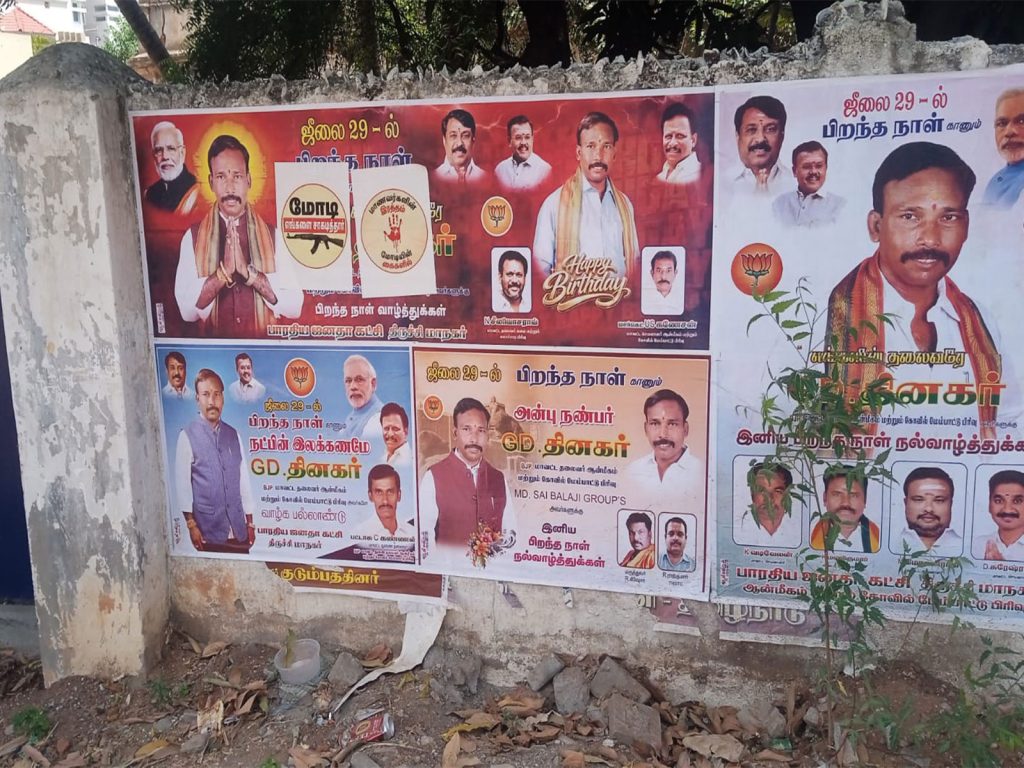
On 15 August 2026, posters carrying alleged derogatory and defamatory messages targeting Prime Minister Narendra Modi were reported at several locations in Tiruchirappalli (Trichy), Tamil Nadu. The incident prompted the Bharatiya Janata Party (BJP)‘s Tiruchirappalli district unit to approach the city police and seek action against those responsible. What happened? According to reports, posters containing statements directed against PM Modi appeared in different parts of Tiruchirappalli. The BJP described the material as defamatory and objected to the manner in which the Prime Minister was portrayed. BJP district president K. K. Ondimuthu reportedly approached the Trichy City Police Commissioner, requesting that the police identify the people responsible for printing and putting up the posters and initiate appropriate legal action. Posters found near BJP office A separate report said that two derogatory posters were found pasted on the compound wall of the BJP office in Vannarapettai, Tiruchirappalli. Police registered a case after Ondimuthu lodged a complaint at the Government Hospital police station. The posters were approximately 1 × 1.5 feet in size and had reportedly been pasted over a birthday poster that had been put up by the district president’s friends. BJP’s response The BJP strongly objected to the posters and demanded that the police investigate the incident. The party’s position was that political criticism should take place through democratic and lawful means rather than through allegedly defamatory posters targeting a constitutional office-holder. The BJP’s complaint also sought to establish who printed the posters, who placed them in public locations, and whether the activity was part of an organised campaign. The police investigation is intended to determine the facts and identify those responsible. Police investigation Following the complaint concerning the posters at the BJP office, Trichy police registered a case and began an investigation. At the time of the reports, the identity and motive of the people responsible had not been conclusively established. Therefore, allegations about which political party or organisation was behind the posters should not be treated as established facts unless confirmed by the investigation. Political significance The incident has significance because it occurred during a period of heightened political activity in Tamil Nadu. Posters, banners and other forms of political publicity are frequently used by parties and groups to express support or opposition to political leaders. When such material is alleged to contain defamatory or objectionable content, it can lead to complaints to the police and potential legal proceedings. The BJP’s demand for police action therefore focuses on accountability, identification of those responsible and enforcement of applicable law rather than merely removing the posters. Impact on Tiruchirappalli For Tiruchirappalli, the incident adds to the district’s ongoing political activity and highlights the importance of maintaining public order during politically sensitive periods. Authorities will need to balance political expression with laws governing public displays, defamation and other potentially unlawful content.

Politics

Udhayanidhi Stalin criticises TVK government in Trichy

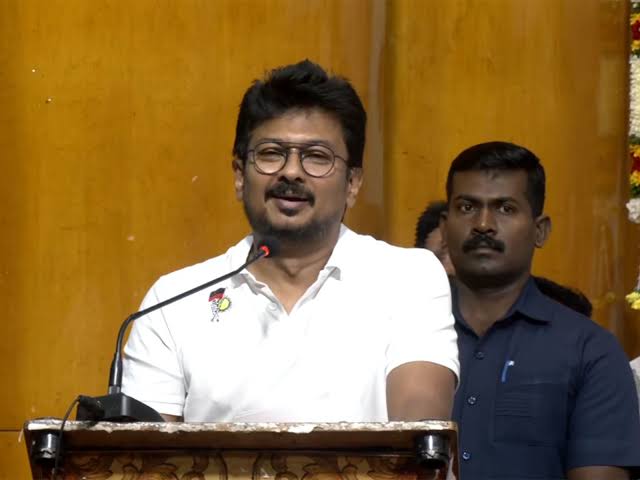
On 23 August 2026, Tamil Nadu Leader of Opposition and DMK leader Udhayanidhi Stalin sharply criticised the ruling Tamilaga Vettri Kazhagam (TVK) government during his visit to the Tiruchirappalli region. His remarks were part of a wider political confrontation between the DMK and the TVK government led by Chief Minister C. Joseph Vijay. Recent reports say Udhayanidhi accused the administration of administrative failures, failure to fulfil election promises, and inadequate attention to farmers’ problems, particularly issues affecting the Cauvery delta. Main points of his criticism Udhayanidhi questioned the functioning of the new TVK administration and argued that the government should concentrate more on governance and public welfare rather than political publicity. In his criticism of the government’s Assembly performance, he questioned whether the administration was functioning as a serious government and alleged that some ministers were more interested in Instagram reels and publicity than legislative responsibilities. He also raised concerns about Cauvery water availability and the condition of delta farmers. According to his allegations, the non-release of sufficient Mettur water had contributed to drought-like conditions affecting farmers in the Cauvery delta. He argued that the government needed to take stronger measures to protect agricultural interests. Election promises Another major criticism concerned promises made by the TVK during the election. Udhayanidhi alleged that the government had not fulfilled important commitments, including: These allegations were presented by Udhayanidhi as evidence of what he described as administrative shortcomings in the new government. Cauvery water issue The Cauvery water dispute has become one of the most important points of confrontation between the DMK opposition and the TVK government. Udhayanidhi has repeatedly accused the government of not doing enough to protect Tamil Nadu’s interests in relation to water releases from Karnataka and the proposed Mekedatu project. The dispute is particularly important for the Cauvery delta because agriculture in the region depends heavily on timely water availability. Political confrontation with the TVK The criticism in Trichy comes amid an increasingly intense political contest between the DMK and TVK. Udhayanidhi has previously accused the TVK administration of using police and legal action against political opponents. Following his recent arrest in connection with remarks made during a farmers’ protest, he alleged that the government was attempting to divert attention from major public issues. The TVK, however, has strongly rejected his allegations and criticised some of his remarks. Significance for Tiruchirappalli The developments are particularly significant for Tiruchirappalli and the surrounding Cauvery-region districts, where agriculture, irrigation and water management are major public issues. Political statements concerning Cauvery water, farmers’ welfare and government performance are likely to receive considerable attention in the region.

listings
News
Home
jobs
Contact