


District Overview
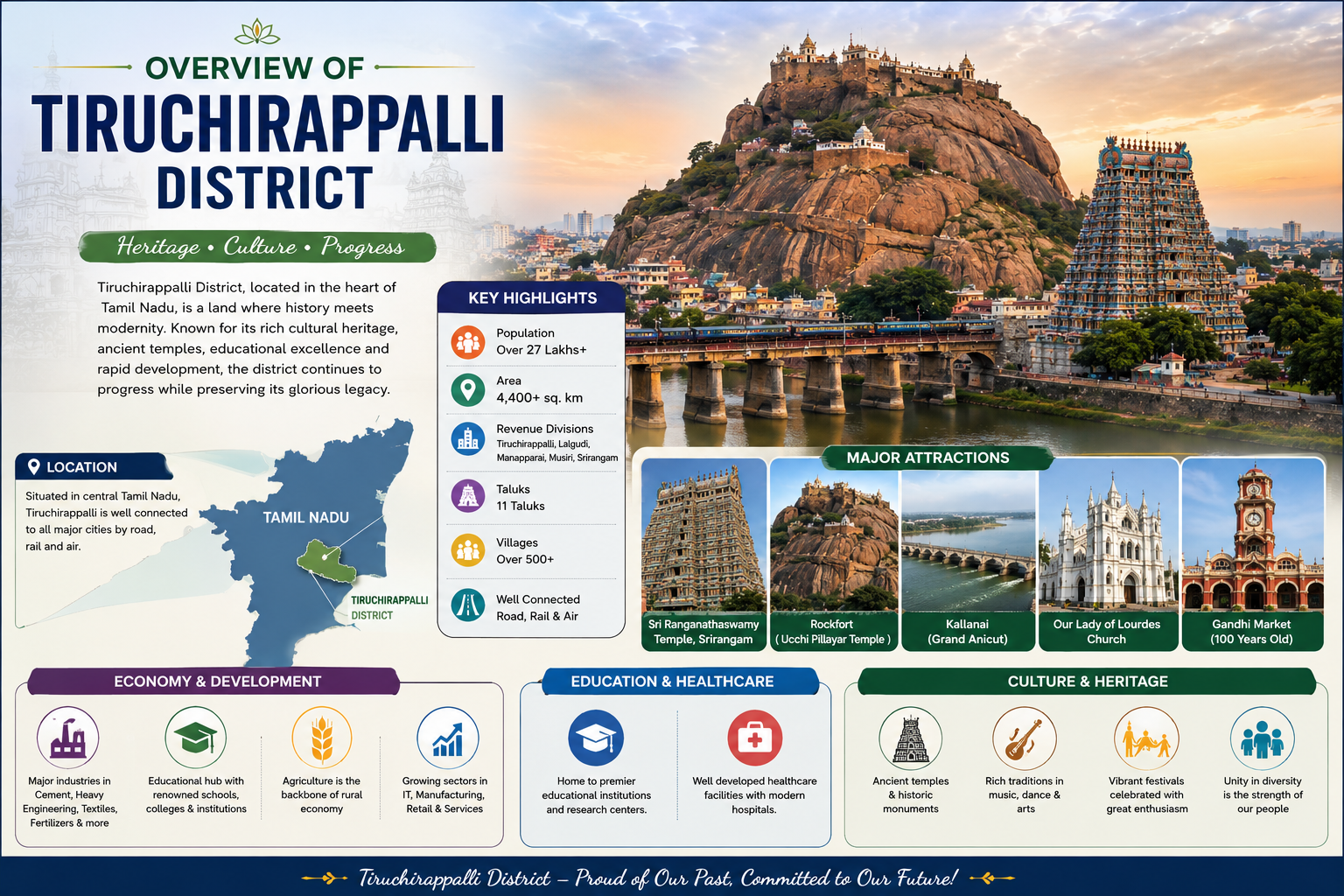
Tiruchirappalli, commonly known as Trichy, is an important district located in the central part of Tamil Nadu. The district is renowned for its rich historical heritage, ancient temples, cultural traditions, educational institutions, and growing industrial and commercial activities.
The district is home to famous landmarks such as Rockfort and the Ucchi Pillayar Temple, Sri Ranganathaswamy Temple at Srirangam, and the historic Kallanai (Grand Anicut). The Cauvery River plays an important role in the district’s agriculture and cultural life.
Tiruchirappalli is also a major transportation and educational hub, with well-developed road, railway, and air connectivity. Institutions such as the National Institute of Technology Tiruchirappalli (NIT Trichy) contribute to its reputation as an important centre for higher education and research.With its combination of heritage, culture, education, agriculture, industries, tourism, and modern infrastructure, Tiruchirappalli continues to play a significant role in the development of central Tamil Nadu.
District Towns
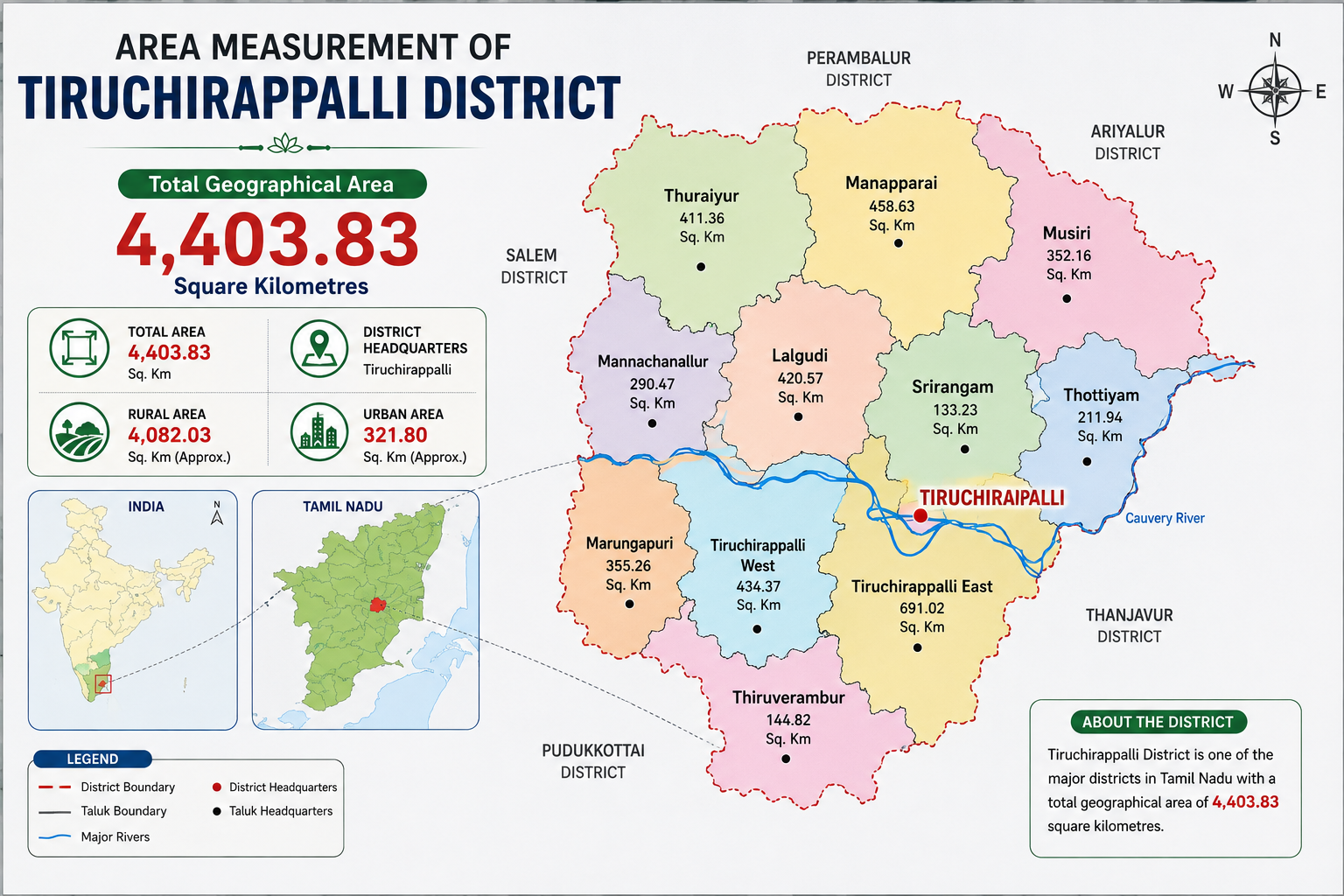
- Tiruchirappalli West
- Tiruchirappalli East
- Srirangam
- Lalgudi
- Manapparai
- Musiri
- Thuraiyur
- Mannachanallur
- Thottiyam
- Thiruverambur
- Marungapuri
Population Chat
For a 2026 website/chart, a commonly cited projection estimates the district’s population at approximately 29,16,662 (29.17 lakh). This is an estimate, not an official Census figure.
| Category | Estimated Population |
|---|---|
| Total Population | 29,16,662 |
| Male | ~14,42,000 |
| Female | ~14,75,000 |
Statistics of Tiruchirappalli District
it is important to distinguish between current administrative statistics and population statistics. The Tiruchirappalli District Administration website, updated in August 2026, still reports the 2011 Census population, so a 2026 population figure should not be presented as
| Statistic | 2026 Information |
|---|---|
| District | Tiruchirappalli |
| Headquarters | Tiruchirappalli |
| State | Tamil Nadu |
| Area | 4,403.83 sq. km |
| Official Census Population | 27,22,290 (2011) |
| Male Population | 13,52,284 |
| Female Population | 13,70,006 |
| Female per 1,000 Males | 1,013 |
| Revenue Divisions | 4 |
| Taluks | 11 |
| Firkas | 43 |
| Revenue Villages | 507 |
| Development Blocks | 14 |
| Village Panchayats | 404 |
| Municipal Corporation | 1 |
| Municipalities | 5 |
| Town Panchayats | 14 |
| Lok Sabha Constituencies | 1 |
| Assembly Constituencies | 9 |
Area measurement
Previous history
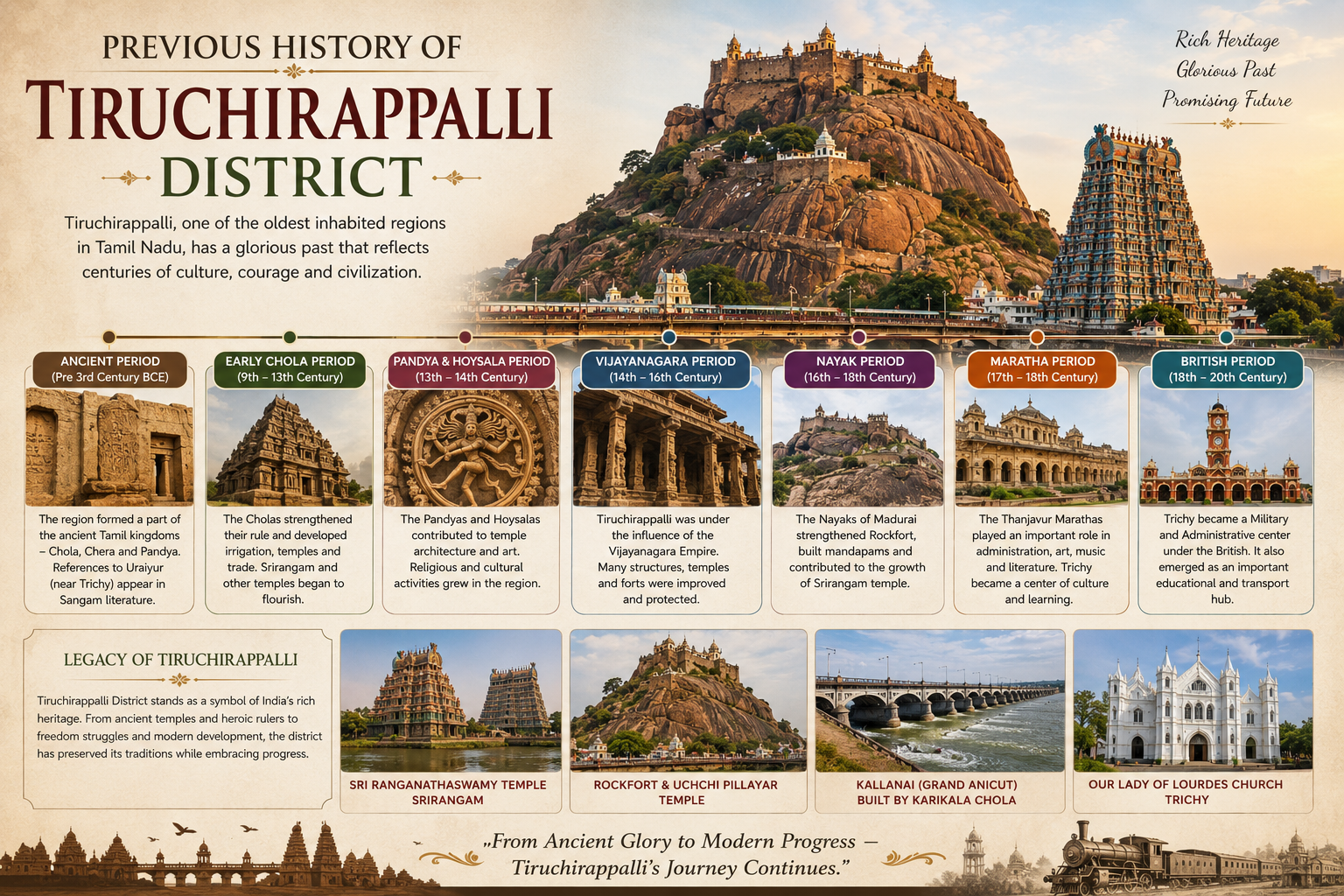
Tiruchirappalli has a long and fascinating history that reflects the rise and fall of several important South Indian dynasties. The region has been associated with the Cholas, Pandyas, Pallavas, Hoysalas, Vijayanagara rulers, and the Nayaks of Madurai. Its strategic location along the Cauvery River made it an important centre for administration, trade, agriculture, and culture.
The Chola period played a significant role in the development of temples, irrigation systems, and agriculture in the region. The historic Kallanai (Grand Anicut), traditionally attributed to Karikala Chola, remains an important example of ancient Tamil engineering.
During the Nayak period, Tiruchirappalli became an important political and military centre. The famous Rockfort and its fortifications played a major role in the region’s history. Srirangam, with the magnificent Sri Ranganathaswamy Temple, also developed as a major centre of religion, art, architecture, and culture.
Revenue of Tiruchirappalli District
Tiruchirappalli District’s revenue administration plays an important role in the overall development and governance of the district. Revenue is generated through various sources such as land revenue, property-related charges, registration fees, taxes, government services, and other administrative collections. The revenue department is also responsible for maintaining land records, collecting government dues, issuing certificates, and implementing various welfare and development schemes.
Agriculture, industries, trade, transport, tourism, and urban development contribute significantly to the district’s economic activity. Tiruchirappalli city, being an important commercial and transportation hub, supports revenue generation through businesses, property transactions, industries, and service-sector activities. The revenue collected by the government is utilized for infrastructure development, public services, education, healthcare, rural development, and other welfare activities across the district.